
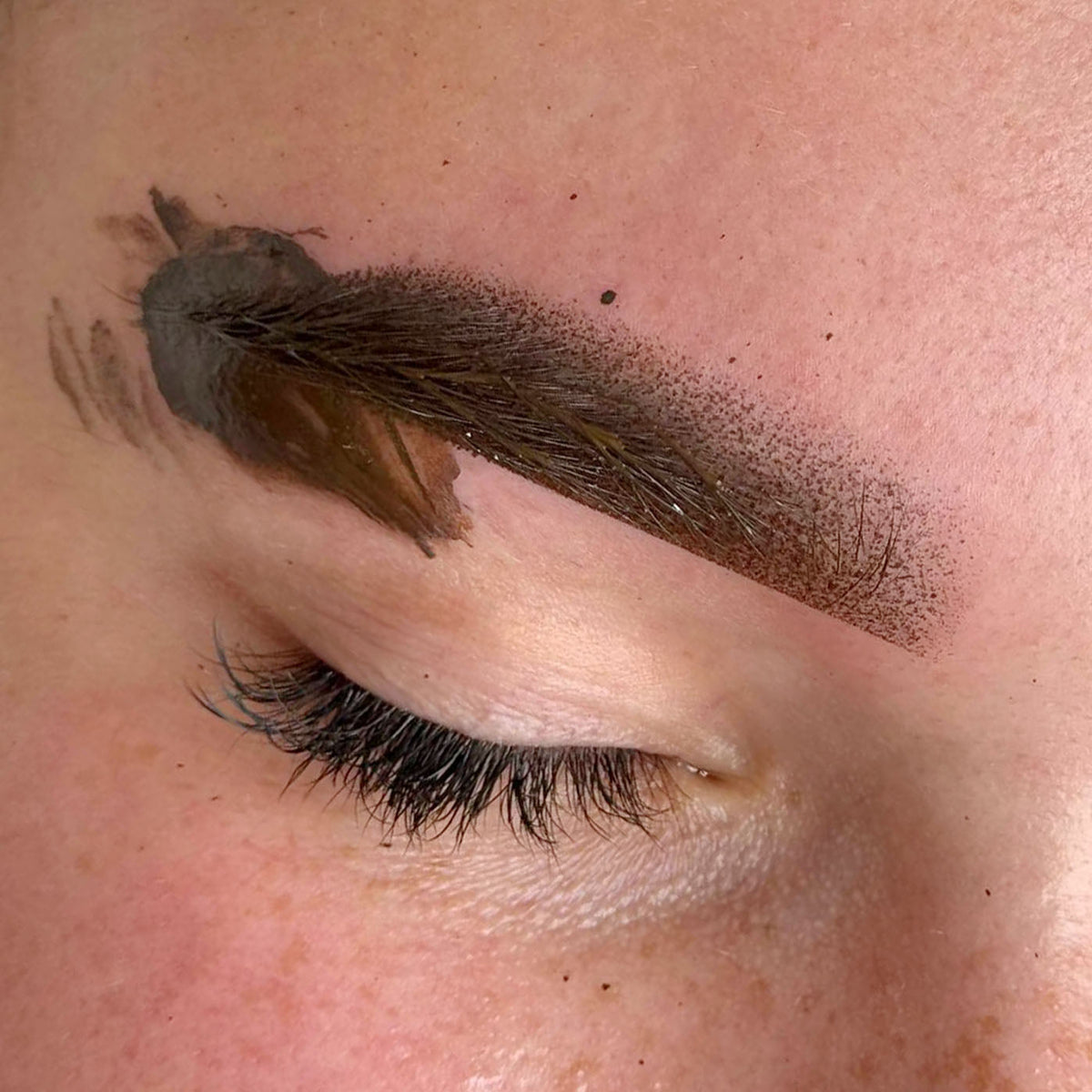
“This skin won’t take pigment” is one of the most common statements made during a difficult pigmentation procedure.
Sometimes the tissue does behave differently than expected. It may be elastic, loose, highly vascular, dehydrated, mature, porous or altered by previous treatments. However, this does not mean that it is biologically rejecting the pigment the moment the needle makes contact.
If pigment is not being deposited during the procedure, the problem usually lies within the system as a whole:
-
the tissue is not stabilised correctly,
-
the needle is not making consistent contact,
-
the hand speed does not match the operating frequency,
-
pigment is not reaching the tip consistently,
-
the cartridge is changing the machine’s behaviour,
-
the machine is not maintaining the expected movement under load,
-
the artist is trying to compensate for the problem by applying pressure.
Before concluding that the “skin won’t take pigment,” we need to identify which part of the system is not performing as expected.
Two Different Problems That Are Often Described in the Same Way
The statement “the pigment isn’t going into the skin” may describe two completely different situations.
The Pigment Is Not Visible During the Procedure
After the area is wiped, the colour appears weak, uneven or almost completely disappears. The artist repeats the passes but does not see a proportional improvement.
This is primarily a problem related to contact mechanics, technique, pigment flow or the interaction between the machine and cartridge.
The Pigment Was Visible but Disappears After Healing
Immediately after the procedure, the result appears intense and even. After several weeks, however, very little colour remains or gaps become visible.
In this situation, it is necessary to analyse not only implantation but also tissue trauma, working depth, biological response, aftercare and how much of the visible result was actually pigment deposited within the tissue rather than pigment remaining on its surface.
These two problems cannot be diagnosed in the same way.
What Must Happen for Pigment to Be Deposited?
Effective implantation requires three conditions to be met simultaneously:
-
The needle must make consistent contact with the tissue.
-
Pigment must be present on the needle and inside the cartridge tip.
-
The number and distribution of contacts must correspond to the speed of the hand movement.
If even one of these conditions is not met, the artist may perform many movements without achieving the expected pigment density.
Simply increasing the number of passes will not solve the problem. If the original cause remains unchanged, every additional pass repeats the same mistake.
Tissue Stabilisation: The Needle May Deform the Tissue Instead of Penetrating It
The skin and vermilion are not static surfaces. They are elastic, deformable tissues that can move under the pressure of the needle.
If the area is not stretched and stabilised correctly, part of the needle’s movement is absorbed by tissue deformation. The surface moves away with the needle before effective contact can occur.
The artist may then believe they are working at the correct depth because the machine is touching the skin, while the needle’s actual movement relative to the tissue is smaller than it appears.
Research into microneedle insertion mechanics—although not research into PMU procedures—demonstrates an important mechanical principle: skin tension, tip geometry, contact speed and tissue properties affect the force required to penetrate the stratum corneum. In a model described in 2025, pre-tensioning the skin reduced the force required for penetration. Numerical values obtained from microneedle studies cannot be transferred directly to permanent makeup, but the underlying principle of stabilising a deformable surface remains relevant. Macromolecular Materials and Engineering
Signs of Insufficient Stabilisation
-
pigment deposits more effectively in one direction than another,
-
the result improves immediately after changing the stretch,
-
the machine begins to “bounce” off the surface,
-
dots are irregular despite consistent hand movement,
-
the problem occurs mainly in soft or mobile areas of tissue.
Correct tension does not mean stretching the tissue as much as possible. Excessive tension also changes tissue properties and may make it more difficult to control actual needle contact. The objective is stability, not force.
Hand Speed and Frequency Must Work Together
Frequency indicates how many needle cycles the machine completes per second. However, it does not automatically determine how many contacts occur within each millimetre of the pigmented area.
Working density is determined by the relationship between:
machine frequency ÷ hand speed
In a simplified example, a machine operating at 60 Hz completes 60 cycles per second. If the hand moves twice as fast, the number of potential contacts within the same distance is reduced by approximately half.
This does not mean that every cycle creates an identical dot. The result is also influenced by the angle, depth, elasticity of the skin and the presence of pigment on the needle. However, the relationship between frequency and hand speed explains why copying another artist’s Hz setting often does not produce the same result.
When the Hand Moves Too Quickly
-
contacts are spaced too far apart,
-
gaps are visible after wiping,
-
the artist performs multiple passes,
-
colour builds more slowly than the number of passes would suggest.
When the Hand Moves Too Slowly
-
multiple contacts accumulate within a small area,
-
the tissue response increases,
-
more lymph or blood appears,
-
the surface becomes more difficult to assess,
-
the immediate result may look intense, but healing becomes less predictable.
The solution is not to find one perfect frequency. Frequency, movement and impulse characteristics must be matched to one another.
Needle Protrusion Is Not Pigmentation Depth
The length of needle visible outside the cartridge tip does not tell us how deeply it is actually working within the tissue.
Actual penetration is influenced by:
-
skin deformation,
-
the working angle of the machine,
-
tissue tension,
-
hand pressure,
-
the characteristics of the movement,
-
cartridge tip geometry,
-
taper length and construction,
-
the behaviour of the mechanism under load.
It is possible to work with significant visible needle protrusion while making only very superficial contact with the skin. It is also possible to use less protrusion but work too aggressively because of pressure, an incorrect angle and slow movement.
Increasing needle protrusion should therefore not be the first response to poor implantation.
The Working Angle Can Turn Contact Into Dragging
The needle transfers movement most clearly when the direction of the impulse is controlled in relation to the surface. If the machine is tilted excessively, part of the vertical movement may be converted into lateral movement.
Instead of creating controlled contacts, the needle begins to move across or scratch the tissue.
This may cause:
-
lines instead of regular dots,
-
uneven pigment deposition,
-
increased surface irritation,
-
an apparently intense result before wiping,
-
a weaker result after cleaning the area.
This does not mean that the machine must always be held perfectly perpendicular to the surface. The angle is part of the technique, but it should be a conscious choice rather than an accidental consequence of hand position.
The Cartridge May Deliver Movement but Not Pigment
Even a correctly moving needle will not deposit colour if pigment does not consistently reach its tip.
Pigment flow may be affected by:
-
pigment viscosity,
-
the width and profile of the cartridge tip,
-
the fit between the needle and the tip,
-
the method used to load pigment,
-
dried product inside the tip,
-
the angle of the cartridge,
-
needle speed.
A cartridge tip may appear to be full without the correct amount of product reaching the working section of the needle.
A Simple Diagnostic Test
Perform several controlled movements on latex, then clean the cartridge tip and reload it with pigment.
If the first movements are clearly visible but the following ones quickly lose intensity, analyse the pigment flow and tip construction. If all movements are weak, the cause may lie in the settings, hand movement, cartridge or needle itself.
The Cartridge Changes the Load on the Machine
Once the cartridge is installed, the machine must overcome membrane resistance, guiding friction and the mass of the moving components.
Two cartridges with the same 0.30 1RL LT specification may differ enough in resistance to make the machine behave differently, particularly at low frequencies.
If the machine’s sound changes noticeably, it slows down or begins to operate irregularly after a particular cartridge is installed, do not immediately compensate by applying more pressure.
Replace the cartridge first and check whether the problem continues.
The Setting Displayed on the Screen Does Not Always Describe Performance Under Load
In simpler systems, the drive can lose a noticeable amount of speed as the load increases. In machines that measure speed and use active control, the system may adjust the motor output to maintain the selected frequency.
However, this does not mean that every machine set to 60 Hz generates identical contact.
The characteristics of the impulse are also affected by:
-
motor construction,
-
torque,
-
eccentric mechanism,
-
the mass of moving components,
-
clearance and friction,
-
stroke length,
-
the control method,
-
the system’s response to changes in load.
This is why volts or Hz should not be treated as complete working instructions.
Can the Tissue Itself Be Part of the Problem?
Yes, tissue properties matter. Differences in elasticity, hydration, stratum corneum thickness, vascularity and collagen organisation affect how the tissue responds to needle contact.
Research into penetration mechanics shows that before the needle actually breaks through the surface, it first deforms the tissue. The extent of this deformation depends on the properties of the skin, tip geometry and movement speed. Proceedings of the Institution of Mechanical Engineers
This does not mean that the tissue “refuses” to accept pigment. It means that the contact must be managed differently.
Instead of increasing force, the artist can adjust:
-
tissue tension,
-
working direction,
-
segment length,
-
hand speed,
-
frequency,
-
cartridge,
-
the amount of pigment inside the tip,
-
the machine’s operating profile.
More Passes Can Reduce Retention
When pigment is not building quickly enough, the natural response is to repeat the movements. However, if the problem results from incorrect contact, every additional pass increases the tissue response without producing a proportional increase in correctly deposited pigment.
An experimental animal-model study found a relationship between needle-surface properties, penetration resistance, tissue trauma and subsequent pigment retention. Its precise results should not be transferred directly to human PMU procedures, but the study supports an important principle: more trauma does not equal better implantation. Scientific Reports
If the tissue begins to react strongly, continuing to repeat the same movement will usually not resolve the original cause.
Step-by-Step Diagnosis
When pigment is not being deposited as expected:
1. Stop
Do not automatically perform another pass. Clean a small section and assess the actual result.
2. Stabilise the Tissue Differently
Change the direction of the stretch or reposition the supporting hand. Check whether the contact becomes more consistent.
3. Check the Pigment Inside the Tip
Clean the cartridge tip, reload it with pigment and perform a test on latex.
4. Replace the Cartridge
A single defective cartridge may generate friction, irregular needle return or incorrect needle guidance.
5. Change Only One Variable
Adjust either the hand speed or the frequency first—not both at the same time. Otherwise, you will not know which change actually improved the result.
6. Check the Angle and Needle Protrusion
Assess whether the needle is creating controlled contact or being dragged across the surface.
7. Observe the Tissue
If swelling increases, excessive lymph appears, pinpoint bleeding develops or the surface becomes difficult to assess, do not try to “force the pigment into the skin.”
Quick Diagnostic Table
| Symptom | What to check first |
|---|---|
| Pigment remains mainly on the surface | Tissue tension, needle contact and pigment flow |
| Colour deposits in only one direction | Tissue stabilisation and machine angle |
| Scratches are visible instead of dots | Angle, lateral movement and needle protrusion |
| The first movements are strong and the following ones are weak | Pigment quantity and flow inside the tip |
| The machine’s sound changes after installing the cartridge | Cartridge resistance or a defective cartridge |
| Latex pigments well but the skin does not | Tissue tension, tissue properties and contact technique |
| The immediate result is intense but heals poorly | Trauma, depth, number of passes and aftercare |
| Applying more pressure does not improve the colour | Stop and identify the underlying cause |
FAQ
If the Pigment Is Not Going In, Should I Increase the Frequency?
Not automatically. A higher frequency increases the number of cycles, but it will not correct insufficient tissue tension, a lack of pigment on the needle or a defective cartridge.
Does Oily Skin Reject Pigment?
Oily or porous skin may require a different working method, but saying that it “doesn’t take pigment” is an oversimplification. The entire process should be analysed first.
Will Applying More Pressure Help Implant the Colour?
Usually, this is not the right solution. Pressure may temporarily increase contact, but it can also increase tissue damage and make the result more difficult to assess.
Why Does Pigmentation Work on Latex but Not on a Model?
Latex is stable and has a more uniform structure. Living tissue deforms, responds biologically and differs between treatment areas. A successful latex test confirms that certain parts of the system are working, but it does not replace proper tissue control.
Can the Machine Cause Poor Implantation?
Yes. The machine can be one of the factors, particularly if it cannot maintain stable movement under load. It is one of the first components that should be checked. A weak or poorly constructed machine may not generate consistent needle movement when resistance increases.
Conclusions
Pigment is not forced into the skin by the power of the machine alone.
Implantation results from the interaction between the tissue, hand, needle, cartridge, pigment, drive mechanism and control system. If one component does not work correctly, increasing pressure or performing more passes may only conceal the problem—and increase the tissue response.
Effective diagnosis begins by stopping and changing one variable at a time.
Do not ask only:
“Why won’t this skin take pigment?”
Ask:
“Which part of my system is preventing me from creating consistent contact today?”

Dejar un comentario
Todos los comentarios se revisan antes de su publicación.
Este sitio está protegido por hCaptcha y se aplican la Política de privacidad de hCaptcha y los Términos del servicio.